.webp)
A truck alert, but a product decision
A temperature log from the truck indicates that an incident occurred. But it doesn’t always specify which pallets were exposed. It doesn’t always indicate how long they were exposed. And it doesn’t necessarily measure the actual level of risk for each logistics unit.
In a refrigerated trailer, not all pallets are in the same situation. Their position in the truck matters. So does their proximity to the doors. The timing of loading, repeated opening and closing of the doors, waiting at the loading dock, and even the thermal inertia of the products can affect their actual exposure.
When in doubt, however, quality decisions must be made at a much more granular level: batch, pallet, order, or even individual product. This is where uncertainty arises. The available data often describes a broad event at the truck level, whereas the decision concerns specific goods. In between, there is a missing layer of traceability capable of linking the incident to the actual logistics units involved.
The Cost of Uncertainty
In the food industry, consumer safety remains a top priority. When there is any doubt about a product’s compliance, caution is essential.
But when the available data is not precise enough, this caution can lead to overly broad decisions: complete blocking of a shipment, transportation disputes, preventive destruction, processing delays, financial losses, and waste.
The problem isn't a complete lack of information. Rather, it's the difficulty in connecting the pieces of information.
The carrier has a temperature log. The warehouse knows which pallets have been loaded. The WMS or ERP system knows the batches and orders. Quality control knows the decision rules. The customer verifies the situation upon receipt.
But if this data remains siloed, it does not provide a quick enough answer to the key question: which logistics units are actually affected?
.webp)
Shifting from a presumption of guilt to a presumption of innocence
The goal is not to track each product individually across all channels. That level of detail would often be too costly or unnecessary.
The goal is more practical: to reduce the margin of uncertainty.
Instead of treating an entire truck as suspicious, more granular traceability can identify specific pallets, lots, or loading areas that may have been exposed.
This changes the nature of the decision.
Some pallets can be released quickly. Others can be inspected. Some can be quarantined. Only goods that are actually at risk can be set aside.
Traceability does not replace quality expertise. It provides a more precise, better-documented, and more actionable foundation for it.
The technologies already exist
Several technological components now make it possible to go beyond simple truck tracking.
Onboard sensors remain essential. They monitor the transport environment. They measure the temperature inside the trailer or in specific compartments of the vehicle. They help detect temperature deviations. But they rarely provide an accurate picture of what each pallet has experienced.
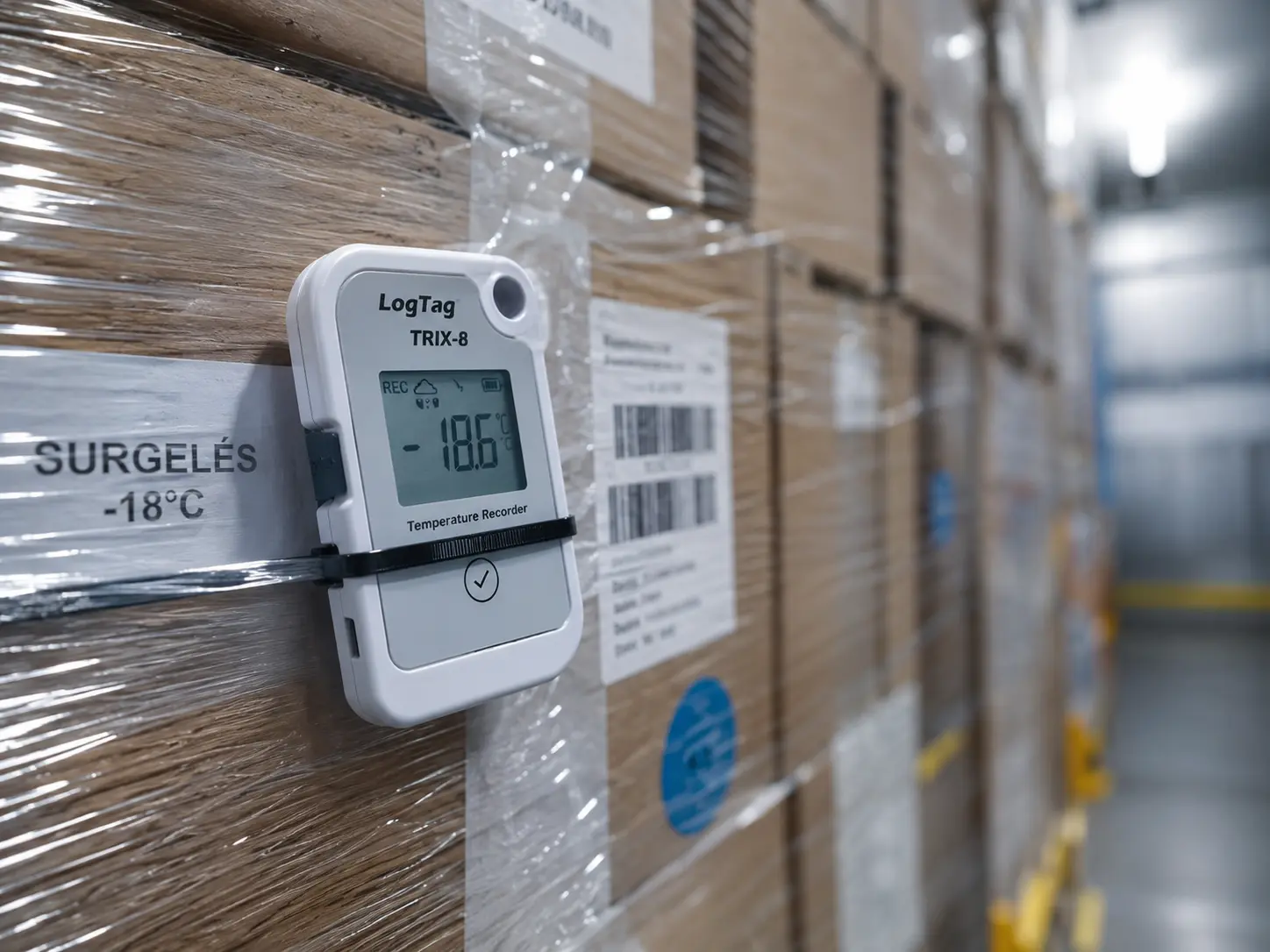
To take things a step further, companies can use temperature loggers, also known as data loggers. These devices measure temperature at regular intervals and store a history of the readings. They can be placed inside a package, within a pallet, on a control pallet, or in a specific container.
Some recorders can only be accessed upon receipt. Data can be retrieved via USB, Bluetooth, NFC, or a mobile app. They are then used to document what happened during transport.
Other devices are connected. They transmit data during transit. These are typically referred to as IoT sensors or connected trackers. They can send real-time alerts, sometimes along with other information such as location, humidity, impact, or whether the device has been opened.
There are also time-temperature indicators. Their purpose is different. They do not always produce a detailed curve. Instead, they indicate that a product or package has been exposed to cumulative temperatures exceeding a defined threshold. They can be useful for identifying a risk of a cold chain break directly at the package or pallet level.
Finally, RFID, NFC, and BLE technologies make it possible to identify and track logistics units. When combined with sensors, temperature loggers, or smart labels, they can link field data to a pallet, a batch, or an order.
Value, therefore, does not come from any single technology. It comes from their combination:
A truck sensor provides an overall reading.
- A truck sensor provides an overall reading.
- A temperature logger records the temperature exposure of a pallet or package.
- An RFID tag identifies a logistics unit.
- An IoT sensor can send a real-time alert.
- A business system is familiar with the batch.
- A quality tool determines the action to be taken.
It is the connection between these elements that creates truly useful data.
The Key Role of Traceability Middleware
In a real-world logistics environment, data comes from multiple sources: onboard sensors, temperature loggers, IoT sensors, RFID readers, smart labels, WMS, ERP, TMS, mobile apps, and quality management tools.
Without coordination, this data remains fragmented. It exists, but it is not always usable when a decision needs to be made.
Traceability middleware creates this link between the field and business systems. It captures events, filters them, and puts them into context. It then forwards them to the appropriate tools.
In the event of a cold incident, this layer can help reconstruct a clear sequence of events:
- which pallets were in the truck;
- which lots were associated with them;
- when they were uploaded;
- what temperature anomaly was detected;
- which logistics units are potentially affected;
- which action should be triggered: release, inspection, quarantine, dispute, or targeted destruction.
So we’re not just talking about technology. We’re talking about operational decision support.
A practical tool for preventing disputes and waste
Improved traceability in the cold chain creates value on multiple levels. For quality teams, it enables faster decision-making based on more accurate data. For transportation teams, it provides a factual basis in the event of a dispute. For customers, it builds confidence in the decisions made. For the company, it reduces losses and prevents unnecessary destruction. And for the environment, it helps reduce waste of products that are still potentially compliant.
Caution will always be essential in the cold chain. But with more reliable and better-contextualized data, that caution can be more effectively targeted.
Conclusion: Measurement alone is no longer enough; we need to put it into context.
The truck sensors have enabled a crucial first step: detecting temperature-related incidents.
The next step is to understand their actual impact.
In temperature-controlled transport, the question is no longer simply: “Has the temperature exceeded a certain threshold?”
The real question then becomes: “Which goods were affected, for how long, and what decision should be made?”
This is where the combination of temperature sensors, logistics unit identification, and traceability middleware really comes into its own. It transforms a general alert into actionable information at the right level of detail.
And in a climate where companies must simultaneously secure their products, reduce litigation, and minimize waste, this capability becomes a real driver of performance. [cta|Contact a Solid expert|/contact]