
The starting point: paper labels always end up coming off
Paper labels work as long as the environment remains stable. But as soon as flows accelerate, the same symptoms appear:
- Information displayed that is no longer accurate (quantity, status, location, etc.)
- Postponed updates
- Additional manual checks to compensate
- Gaps emerging between the field and the system
And that's where traceability becomes fragile, not because your ERP is "bad," but because the data takes too long to reach the field (or to feed back into the system).
What is a smart electronic label?
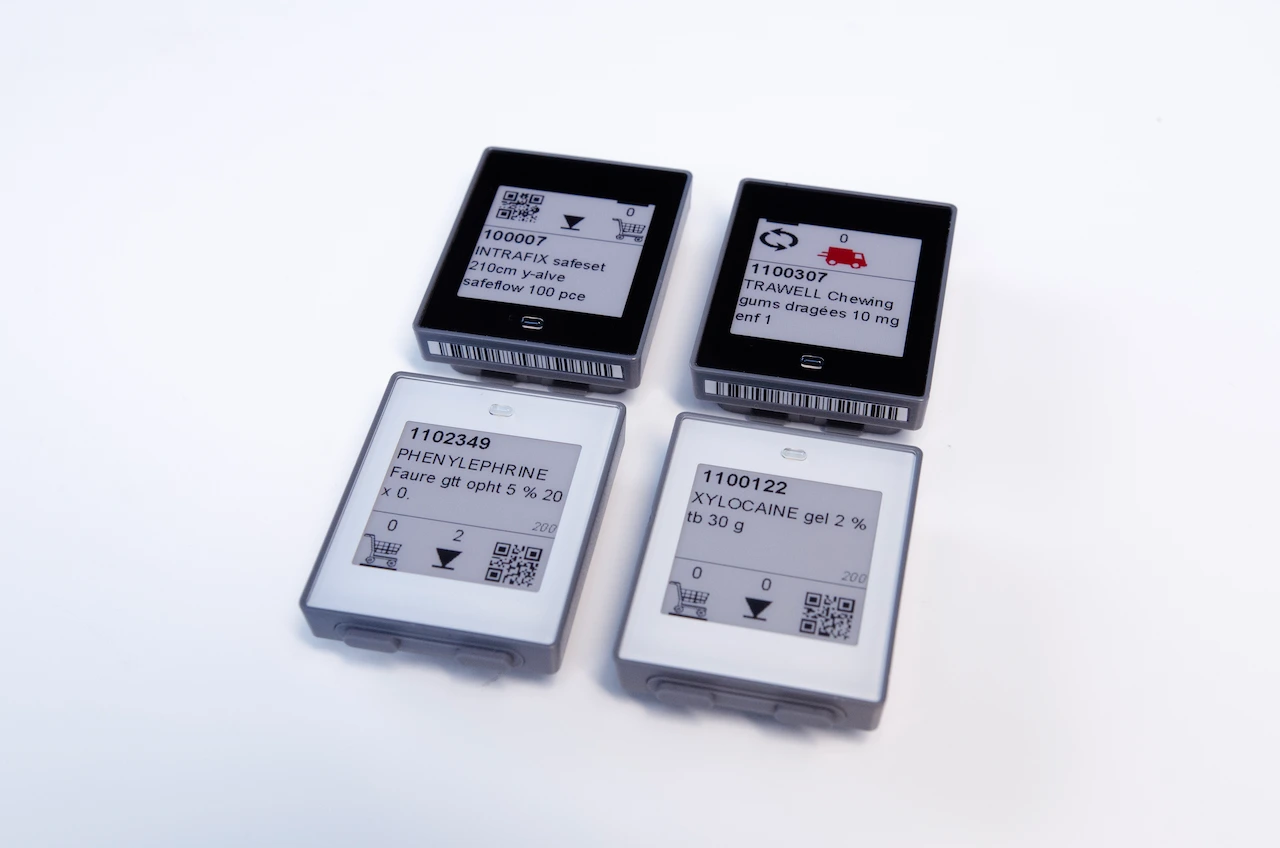
A smart electronic label is a connected label that displays useful information (reference, serial number, status, quantity, location, alerts, etc.) and can be updated remotely without reprinting.
At Solid, our labels are designed for traceability applications in demanding environments:
- E-Ink display (monochrome or color) for long-lasting readability
- Wi-Fi, Bluetooth, Ethernet connectivity
- Long battery life (up to 5 years of operation)
- Robust ness (dust, humidity, heat)
- Quick integration with your ERP and, above all, with our solutions
Why E-Ink is particularly well suited to traceability
The advantage of E-Ink is very concrete: the screen mainly consumes power during updates, then the information remains displayed without continuous power supply. The result: good readability, low power consumption, and limited maintenance. This is exactly what you would expect from a field device that needs to remain reliable over time.
Smart Ink: when labels become low-power digital interfaces
Our smart electronic labels use Smart Ink, a connected electronic labeling approach that transforms the label into a low-power digital interface.
What this means in practical terms
- The tag communicates via a gateway (discreet antenna, easy to install).
- Relevant information is synchronized automatically.
- Updates become fast, reducing discrepancies and manual corrections.
The display can use colors (black, white, red, yellow) to highlight a status or alert without overwhelming the user.

Two approaches to integration: and the one that maximizes value
Smart electronic labels can be integrated in two ways.
Direct connection to your ERP
In some cases, the label receives updates directly from the ERP via the gateway. This approach is quick and easy to implement when the need is very specific, for example, displaying product information, a threshold, or a basic status.
Integration via our solutions (recommended)
At Solid, this is the approach we seek to promote most, as it is the one that creates the most value in terms of traceability.
A direct connection to the ERP is possible, but the maximum value is achieved when the labels are integrated into our solutions (SolWaves,SolCare, etc.), as they then form part of a comprehensive traceability and flow orchestration system.
Why is this difference important? Because in real life, the question isn't just "what data should be displayed?" The real questions are more like this:
- Who triggers the update, and when?
- What business rules apply (threshold, consumption, movement, inventory, transfer)?
- Which statuses are authorized, and by whom?
- Which systems must remain consistent with each other (ERP, WMS, MES, internal tools)?
- How can you avoid double entry and exceptions that end up in Excel?
This is precisely the role of our solutions: to orchestrate, secure, and industrialize these flows so that traceability is usable and reliable at scale.
Why these labels really improve asset traceability
Effective traceability is not just about "knowing where an asset is." It is also about being able to quickly answer simple questions without manual verification:
- What is the status of this asset, here and now?
- Is it available, reserved, under maintenance, pending, incomplete?
- Does what is displayed correspond to what the system believes?
- Can we take action immediately, or should we wait?
Electronic labels improve traceability because they make information visible and up-to-date at the point of use. And in practice, this significantly reduces:
- Errors related to outdated information
- Validations "from memory"
- Search and verification times
- The gap between the field and systems
The most commonly observed benefits
- Less discrepancy between the field and systems
- Fewer corrective tasks (reprints, returns, adjustments)
- Greater responsiveness when a status changes
- Simpler traceability to maintain, even when flows accelerate
How Solid deploys these electronic labels in a project
1. Field framing
We start with reality: which assets, which areas, which points of friction, which information should be visible, and to whom.
2. Defining the source of truth
We clarify where the data lives and what is authoritative: ERP, WMS, internal repository. The goal is simple: to avoid double entry.
3. Gateway setup and network validation
Installation, coverage, real-world testing, and reliability verification in everyday scenarios.
4. Integration
- Option A: Direct ERP integration to labels
- Option B: integration via our solutions (recommended) to manage business rules, statuses, multi-system synchronization, and industrialization
5. Pilot then rollout
We start in an area where the impact is quickly visible, then we expand.
Best practices for success (without complicating things)
- Start with an area where there is already friction, not the "perfect" area.
- Keep the display simple: a label must remain legible and actionable.
- Define a few clear rules that everyone can understand.
- Measure before and after, even with simple indicators (discrepancies, update times, errors, paper maintenance).
Conclusion
Smart electronic labels are not simply a "modern" replacement for paper. They are reliable sources of information, located in the field, where traceability really matters.
Yes, a direct connection to your ERP is possible. But when labels are integrated into our solutions, they become part of a comprehensive approach to traceability and flow orchestration. And that's where you see the difference: fewer discrepancies, fewer errors, and traceability that can finally be leveraged on a daily basis.
.webp)