
Visible excellence is based on invisible logistics.
In the world of fine watchmaking and high-end jewelry, an event is never just about the beauty of a stand or the quality of a client meeting. Behind every impeccable presentation lies a much more demanding reality: that of extremely valuable items constantly moving between secure storage, private showrooms, salespeople, clients, and operational teams.
At events such as Watches and Wonders, this mechanism intensifies. The 2025 edition brought together more than 55,000 visitors and 60 exhibiting companies in Geneva. At this scale, managing items can no longer rely on paper lists, manually updated files, or verbal coordination between multiple parties. The slightest operational blind spot creates risk: risk of loss of visibility, risk of human error, risk of tension in the customer experience, and of course, security risk.
In other words, the real question is no longer simply whether a piece is present on the site. The question becomes much more strategic: where exactly is it located, who is responsible for it, how long ago did it leave the stock, in what context was it presented, and what does its journey reveal about the dynamics of the event?

Why traditional methods are reaching their limits
At a prestigious trade show, flows are fast, simultaneous, and often unpredictable. A room may be requested urgently for a meeting, transferred to a runner, presented in a private lounge, then reassigned to another space a few minutes later. When dozens or even hundreds of references enter into this choreography, traditional methods quickly show their limitations.
Manual tracking naturally introduces friction. It depends on individual diligence, takes up time with little added value, and leaves constant doubt when a piece cannot be located immediately. This doubt is costly. It slows teams down, distracts attention from commercial issues, and undermines the serenity necessary for an event where every interaction must reflect control, discretion, and excellence.
The difficulty therefore lies not only in the volume of items, but also in the need to maintain a reliable chain of responsibility in real time. In this context, traceability is no longer a technological convenience. It has become an operational foundation.
Traceability as an active safety measure
In the luxury sector, security is not just about locking a safe or controlling access. It is also about documenting movements, assigning responsibilities, and immediately detecting anomalies. This is precisely where a traceability solution makes all the difference.
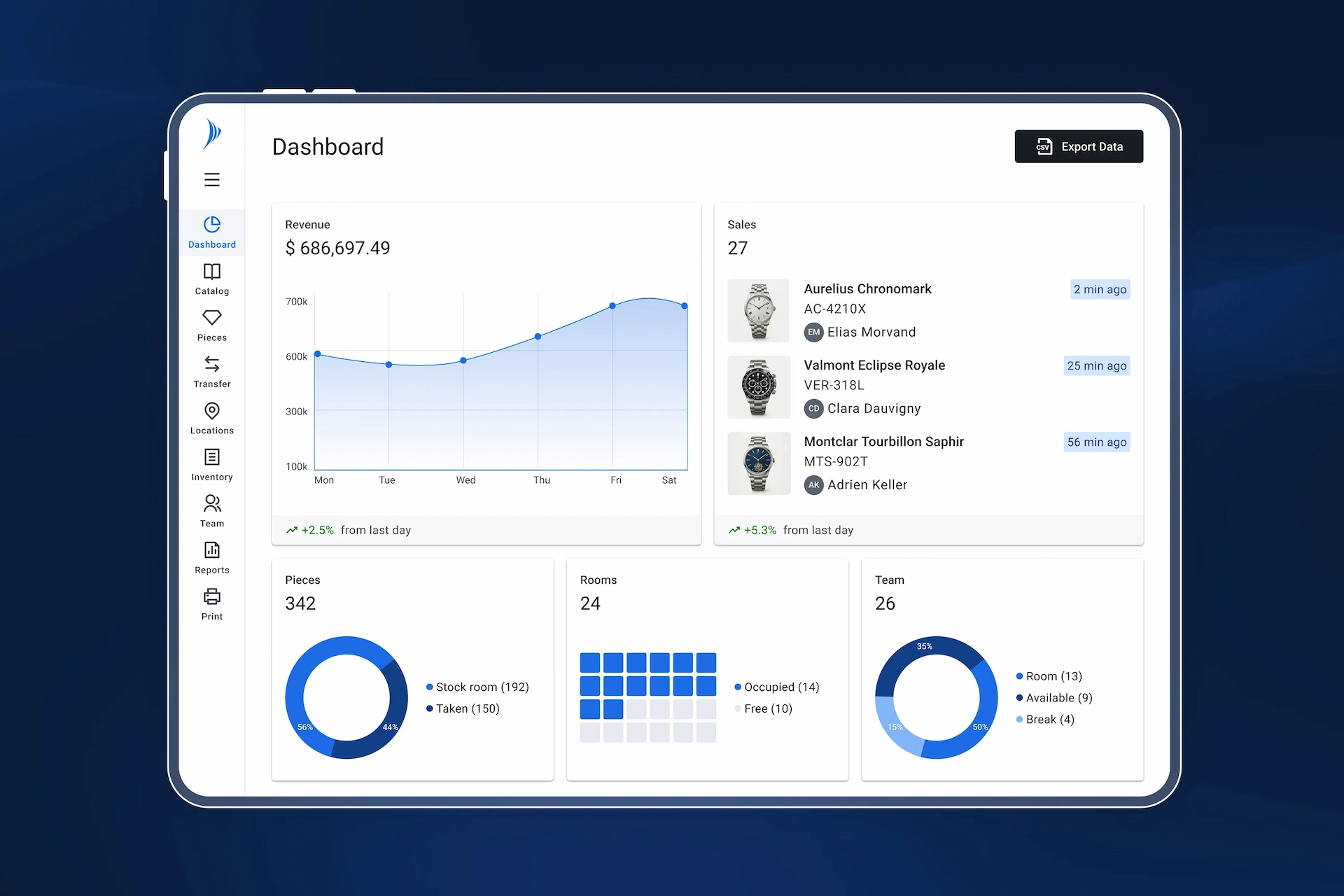
Combined with RFID identification, each item can be recognized quickly and without direct contact. Solutions dedicated to event environments, such as our SolShow, allow, for example, real-time tracking of item movements between storage, runners, and presentation areas, while centralizing information in a single system. At each key stage—removal from storage, transfer to a runner, presentation, return, change of area—information can be recorded and fed into a single system. The benefit is not simply having more data. The benefit is to build a reliable, time-stamped, and shareable view of the movement of items.
This visibility makes it possible to immediately know whether an item is still in stock, in transit, on display, or awaiting return. It also makes it possible to identify the last person responsible, track movements between zones, and trigger alerts when a flow deviates from the planned route. In an event environment, this ability to react quickly is essential. It reduces risk, reassures teams, and secures the entire system without weighing down the customer experience.

Faster, more frequent, and therefore more useful inventories
For a long time, inventory was seen as a constraint at the end of the day: a necessary step, often time-consuming and sometimes stressful. However, at a premium event, inventory is not just a count. It is an indicator of operational control.
RFID is changing the nature of inventory management. It is now much faster and can be carried out without significantly disrupting business operations. Specialized solutions such as SolShow can reduce the time spent on inventory during premium events by up to ten times, while providing real-time visibility into the movement of items. In other environments, scans can cover very large volumes in a matter of minutes, where manual checks would require much more time and resources.
This benefit should not be reduced to a mere increase in productivity. When inventory is taken quickly, it can be conducted more frequently. When it is conducted more frequently, it reduces the window of uncertainty. And when it reduces uncertainty, it improves safety, managerial confidence, and operational efficiency. This is the very essence of real-time management coming into play. [cta|Discover our solutions|/solutions]
Beyond security: the decision-making value of data
This is often the most underestimated benefit. A watchmaking or jewelry event generates a considerable amount of behavioral and operational data. However, it is still necessary to be able to capture it properly.
Which items are in highest demand? Which ones circulate the most without resulting in a long presentation? At what times of day do requests intensify? Which areas generate the highest traffic? Which runners are in highest demand? Which product families justify increasing on-site stock for the next edition?
Without a traceability system, these issues are often dealt with intuitively. With structured data collection, they become actionable indicators. Sales teams can better understand the real interest generated by certain products. Event managers can adjust inventory distribution, human resources, and space organization. Management finally has a factual basis for making decisions rather than relying on fragmented impressions.
This data-driven dimension is consistent with the general evolution of the market. According to Accenture, RFID adoption in European retail has risen from 27% in 2018 to 77% in 2020, mainly because this technology is not limited to inventory management: it also supports high value-added analytical and decision-making applications.
A smoother customer experience, without compromising on standards
In the luxury sector, operational performance is only valuable if it remains invisible to the customer. Good traceability should not create noticeable complexity; on the contrary, it should streamline the experience.
When a team knows instantly where a part is located, who can deliver it, and within what reasonable time frame it can be presented, the quality of service changes dramatically. Waiting times are reduced, internal exchanges become more fluid, and employees remain focused on their primary role: supporting the customer, promoting the part, and creating the conditions for a privileged relationship.
Technology plays an orchestrating role here. It connects the field, security, and management in a single information flow. In IT terms, we could say that it acts as a source of operational truth, capable of aligning physical actions and useful data for management in real time. For companies seeking service excellence, discretion, and risk control simultaneously, this alignment becomes particularly valuable.
From a defensive issue to a strategic advantage
The traceability of parts during an event has long been seen as a defensive issue: preventing loss, limiting errors, and ensuring safe handling. This interpretation remains accurate, but it is now incomplete.
Today, a well-designed solution makes it possible to secure flows, speed up inventories, strengthen team accountability, streamline customer presentations, and transform every movement into a decision-making signal. It converts a logistical constraint into a management lever.
For players in the watchmaking and fine jewelry industries, the question is no longer whether traceability adds value. The question is how much longer it is acceptable to manage events of such intensity without real-time visibility.
As event organizers seek greater security, responsiveness, and operational intelligence, traceability is emerging as an essential component of premium events. Not as a mere add-on, but as a discreet infrastructure that supports excellence. [cta|Contact one of our experts|/contact]
.webp)