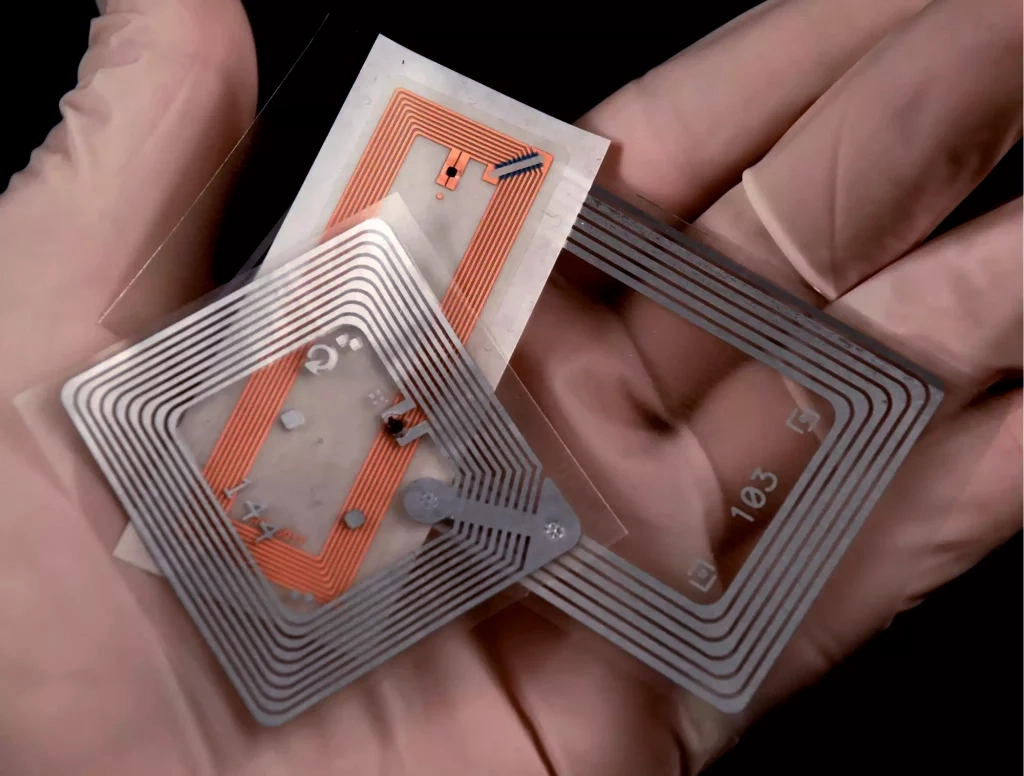

major benefits of RFID technology for its inventories
1. Significant time savings
Forget tedious and time-consuming inventories. Unlike barcodes, RFID scanners allow for mass reading by scanning hundreds of items in a matter of minutes without needing to view them. For example, a 300m2 warehouse can be inventoried in just 3 minutes. This unmatched speed saves you valuable time by performing semi-automatic inventories, thereby increasing your productivity and reducing operation times.
2. Improved accuracy
No more manual counting errors. RFID provides up-to-date inventory accuracy, virtually eliminating data entry errors. This enhanced accuracy ensures better management of your inventory or assets and greater confidence in your inventory data.
3. Cost reduction
Reducing errors, cutting down on inventory time, and improving inventory or asset management translate into overall cost savings. The direct return on investment is around 18 months. Added to this are operational efficiency, reduced stress for employees, and increased security in the management of sensitive equipment.
4. Enhanced data security
Unlike barcodes or QR codes, RFID makes it almost impossible to falsify data. The security of your inventory is also greatly enhanced, as the RFID tag will trigger an alert if a product is moved when it shouldn't be. For example: Anti-theft terminals in stores.
5. Simplified automation and integration
The collected data can be easily integrated into your ERP system. This integration facilitates process automation, reducing manual tasks and increasing operational efficiency.
Discover how RFID allows you to geolocate your products!
Specific case study of RFID inventory management
How RFID inventory works
Conducting inventory using RFID technology requires a system based on the interaction between several key components. Here is a detailed overview of each component and its role in the inventory process.
RFID tags: The heart of the system
- Types of tags: There are two main types of RFID tags— active and passive. Active tags are powered by an internal battery and can transmit signals over longer distances. Passive tags, on the other hand, do not have their own power source and are activated by energy from RFID readers. The tag can be integrated into a label, card, or more robust medium. The size of the tag directly affects the reading distance. A 30mm by 20mm label with an embedded tag can be read from up to 2-3 meters away.
- Tag programming: Each tag is programmed with information unique to the item to which it is attached. This information may include the product ID, date of manufacture, expiration date, and other relevant data.
- Durability and adaptability: RFID tags are designed to withstand harsh environments and can be adapted to a variety of products, from small consumer items to large industrial equipment. The lifespan of a passive tag depends solely on the adhesive applied to the substrate. Since the tag does not emit any waves, its lifespan is measured in decades.
Readers: Signal interpreters
- How readers work: RFID readers send out radio waves to activate tags and receive the information they contain. These readers can be fixed or portable, offering flexibility in how inventory is carried out.
- Range and read speed: Range and read speed vary depending on the type of reader and tag. Some systems can read hundreds of tags per second from several meters away, making inventory quick and efficient.
Management software: The analytical brain
- Data processing: Once the information is captured by the readers, it is transmitted to the management software. This software is the brain of the system, processing and analyzing the collected data.
- Integration and analysis: The software can be integrated with other business management systems for comprehensive analysis. It provides detailed reports on inventory status or the location of your assets, enabling businesses to make informed decisions based on accurate data.
Steps for optimized inventory management
1. Needs analysis with the client
The first step is to understand your specific needs. This involves analyzing your current inventory and storage processes to identify challenges and opportunities for improvement.
2. Define the appropriate solution
Based on this analysis, we work with you to determine the most appropriate solution. This may include choosing technologies, customizing labels, selecting readers and antennas, and defining software requirements.
3. Software development and customization
Based on your requirements, we develop and customize software that will integrate seamlessly with your system. This software will be the core of the solution, enabling easy and efficient management of your inventories.
4. Setting up equipment on site
Passive RFID traceability does not require any specific infrastructure. The RFID tag is incorporated into your labels during production, and the antennas used to read them are the same size as a 1D/2D code reader. In some environments, it may be beneficial to add fixed antennas. In this case, we ensure that they are perfectly integrated into your working environment.
5. Training and support
Once the solution has been integrated, we provide comprehensive training for your teams. We also support you during the transition phase to ensure smooth and effective adoption of the technology.
Through these different stages, we help you take the leap towards optimized inventory management, allowing you to reap the full benefits of RFID technology.
Investing in RFID technology
Spoiler alert: The hardware costs of an RFID solution are not as high as you might think!
Our 25 years of experience have shown us that the costs of implementing an RFID solution are always overestimated. An example will illustrate this point.
One of our clients in the luxury goods industry produces around 3 million items per year. They wanted to identify and track the movements of their items across their main sites so that they could then carry out an inventory when the items leave the site and are distributed to stores around the world.
When stores needed to restock their inventory, the items were inventoried, placed in a cart, loaded onto a truck, and sent to the store. Upon arrival at the store, the items were inventoried again. Whether at delivery or upon arrival, inventorying approximately 500 items took a maximum of two minutes.
All data was sent back to the ERP system to validate receipt. It should be noted that if a part is removed from the stock area before being inventoried, an alert is sent.
Customer benefit: Significant time savings for operational staff, zero risk of error, and enhanced security through comprehensive traceability throughout the chain.
Budget to be allocated:
- Labels: 7 cents per label
- Infrastructure: CHF 20,000 (mobile and fixed antenna)
The ROI for this solution was calculated over a period of 15 months.
Key information to remember
RFID (Radio Frequency Identification) is transforming inventory management by enabling fast, accurate, and contactless tracking of products.
Advantages of conducting inventory using RFID:
- Considerable time savings: Automatic or semi-automatic inventory, for example, a 300m² warehouse in 3 minutes.
- Improved accuracy: Elimination of manual counting errors.
- Cost reduction: Labor savings and reduction in costly errors.
- Enhanced security: RFID data is difficult to falsify.
- Automation and integration: Easy integration of RFID data into existing management systems.
How it works: Tags, readers, and software solution.
Implementation: Needs analysis, solution definition, customized software development, hardware installation, and training.