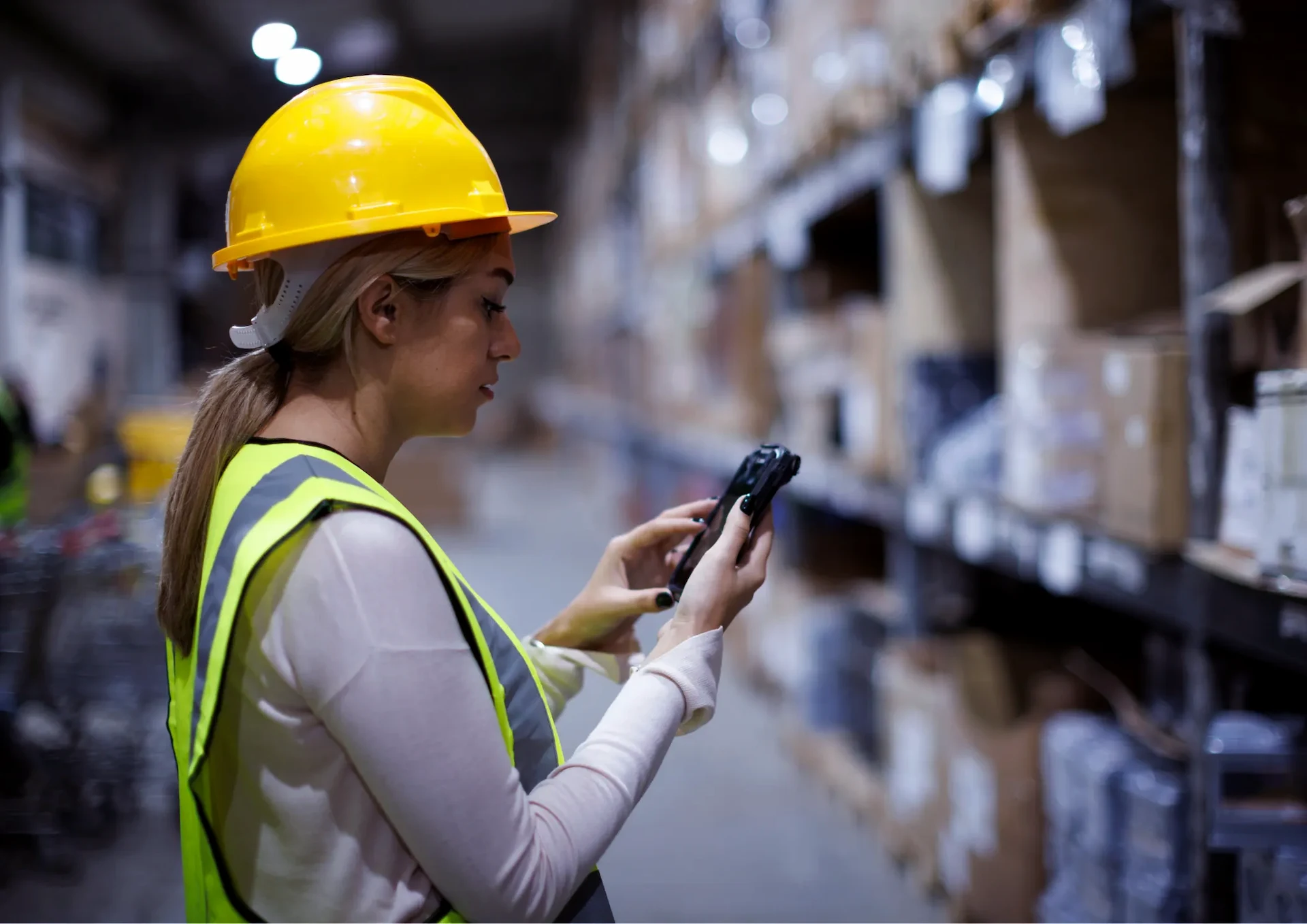

Whether it's to increase productivity, minimize stock discrepancies, or know the location of products in real time, RFID geolocation is currently experiencing a real boom.
And that's good news: there is a wide range of technologies available, adaptable to many budgets and needs. How do they work? In what areas are they used? How do you choose the best geolocation system, based on your budget and desired accuracy?
Let's dive into this world of technology, which largely lives up to its promises.
Focus on RFID geolocation
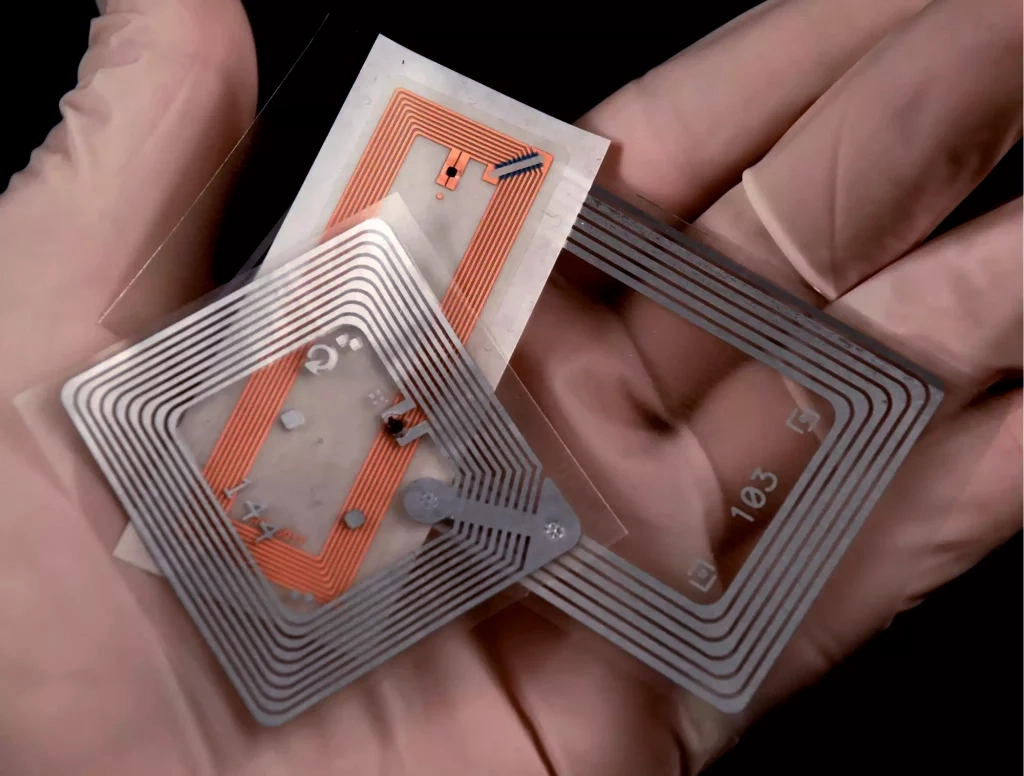
The operating principle of RFID, also known as radio frequency identification, relies on radio waves to transmit information. In practical terms, such a system consists of two elements:
- A passive RFID tag. It takes the form of a chip connected to an antenna. This receiver is attached to the item to be tracked, whether it be furniture, samples, the sides of a pallet, a clothing label, or the packaging of a parcel, for example.
- An RFID reader, sending requests and receiving data using electromagnetic waves.
Of course, while these two elements form the core of RFID communication, you still need to be able to use the information collected. In business, a data management system is therefore used to synthesize and transcribe this information in a readable format in your files, so that it can be integrated into your processes.
By linking RFID technology to your ERP, WMS, or LIMS systems, for example, inventory adjustments can be made instantly! In addition to saving time, this is also an innovative way to optimize your processes and anticipate product shortages.
The advantages of an RFID solution
Among traditional identification systems, we can of course mention barcodes and the more recent QR codes. Although they are inexpensive and widely used, they do have limitations for industries and professionals. They do not allow for precise geolocation of your product. In this respect, RFID geolocation technology is significantly more powerful. Unlike manually scannable systems, it allows each item to be located in real time, even without seeing it, as long as it is within range of the reader.
The time savings inherent in such a solution are phenomenal, since everything is digitized. Simply send a request to find out where the item you are looking for is located, saving you many minutes of searching through your premises. It is ingenious both for your brand image and for your industrial efficiency, not to mention the possibilities it offers in terms of automation and compliance with any standards that may be imposed on you.
RFID geolocation solutions
We can differentiate between active RFID tags and passive RFID tags. Passive tags are the most common and least expensive. Contrary to popular belief, they do not allow for real-time geolocation on their own. You will need to set up different infrastructures depending on your accuracy requirements.
In order for the information stored in passive RFID tags to be read and used, they must be within range of a reader. Various systems exist for this purpose.
Geolocation via RFID gates: essential in warehouses and factories
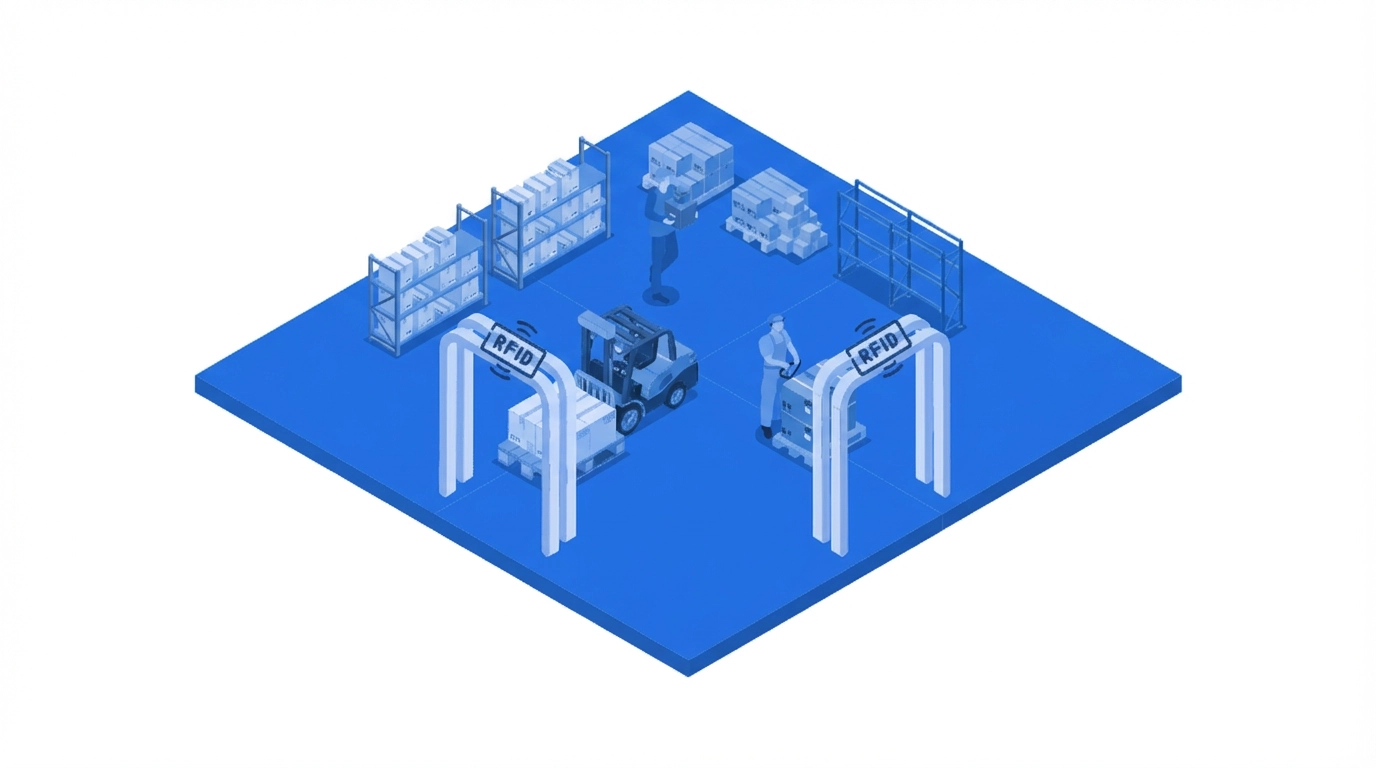
RFID gate geolocation is a strategic system for tracking your products throughout your supply chain. It automatically detects all chips passing underneath it. The principle is simple: whether you work in a factory, warehouse, or laboratory, the idea is to install gates equippedwith RFID antennas at all the stages you want to monitor. As soon as a tagged item is scanned, the information is automatically sent to your inventory management software.
It is an ingenious system that will not let any product slip under the radar. Even if a pallet containing several hundred chips were to pass under your gate, it would be read instantly.
This method allows you to accurately track the location of your product in real time throughout your production chain. This helps you optimize your processes, limit losses, and improve operational efficiency.
Geolocation via RFID wall antenna: particularly in hospital environments
If you simply want to locate your items without needing to track them throughout your supply chain, RFID antennas are also an option. More discreet than gates, they can be installed at the entrance/exit of a cold room, a room, a meeting room, etc. As a result, as soon as a product passes near this antenna, it will detect it and report it to your system. This gives you visibility of your product's last location and allows you to define the area where it is located.
The range of these antennas varies depending on your environment, the size of the chip, the preset settings, and many other factors that need to be taken into account.
This method can give you real-time visibility of your incoming and outgoing flows. It also allows you to check whether a part remains in its location. For example, an audible signal can be emitted by the antenna if it leaves the room without authorization.
This RFID antenna tracking system is widely used in hospitals for equipment, archive document management, and artwork tracking.

Geolocation via NFC: the example of samples
NFC ( Near-Field Communication ) geolocation also allows objects to be tracked in real time. This requires the use of NFC RFID chips and NFC antennas. Here, communications take place over very short distances, no more than a few inches, which also ensures the security of your products.
This method can be used to geolocate samples in refrigerators or vials in cabinets, for example. The shelves in your current cabinets will be replaced by smart shelves equipped with NFC antennas. Each sample will be equipped with a chip, and as soon as a sample is placed on the shelf, the information will automatically be fed back into the system. You will be able to see in real time where your samples are located in your cabinets.
Detection is fast and accurate, and if relevant in your case, variations in liquid quantities are also taken into account. This system also allows you to take inventory or transfer mass between two refrigerators using a mobile RFID reader.
This is therefore a major asset in the pharmaceutical and hospital sectors, preventing stock shortages while showing you where your products are located, resulting in a significant increase in productivity!
Discover our SolWaves solution: Geolocate your products
Why should businesses invest in RFID geolocation?
As mentioned above, an RFID geolocation system uses chips to track the location of people or products. It can therefore be used in many different settings, including production lines, hospitals, and the luxury goods sector.
Here are a few examples of applications.
RFID tracking in industry
Whether you own a production plant, warehouses, or oversee logistics circuits, investing in RFID will enable you to:
- Complete your inventory in record time.
- Comply with traceability requirements, particularly in the pharmaceutical sector.
- Automate certain repetitive tasks in your processes, such as warehouse receipts and shipments.
- Optimize the management of your inventory and supply chain.
- Reduce the time spent searching for your products...
As factories handle increasingly large volumes of products while responding to significant competitive and regulatory challenges, RFID geolocation is a valuable ally.
RFID in the healthcare sector
The pharmaceutical and hospital sectors are also major users of RFID chips, particularly for:
- Equipment tracking, to save time for healthcare staff.
- The traceability of medical records.
- The location of patients, particularly in hospitals and nursing homes.
- Geolocation of samples in refrigerators.
The benefits of radio frequency identification in the luxury sector
The world of luxury goods involves handling exceptional items that must be easily secured and located. Similarly, proving their value and origin can quickly become essential, hence the use of RFID, which allows you to:
- Securing items displayed in luxury stores or presented at events...
- Management of components during production stages.
- Location and optimization of component/finished product inventories.
Of course, a range of other sectors may require the use of RFID chips. From tracking livestock to locating your four-legged pets, to event wristbands for access control, the possibilities are endless!
Other real-time location systems (RTLS)
The geolocation systems mentioned so far rely on passive RFID chips. In other words, they do not send information but are only read, and do not have batteries that need to be recharged. However, these are not the only ones that can be used! In fact, there are a multitude of different RTLS technologies, including active chips that operate remotely.
Here are five of the most popular solutions.
1. BLE, or Bluetooth Low Energy
As their acronym suggests, BLE location systems rely on Bluetooth communication involving low energy consumption, nearly 10 times lower than that of conventional Bluetooth. Unlike passive RFID chips, BLE chips are equipped with a small battery. They are inexpensive and capable of reading a beacon from several dozen meters away, easy to implement, and have a long battery life (several years). This makes them ideal for use in warehouses.
Similarly, the use of such equipment requires Bluetooth compatibility between all components, which is an important factor to consider. To make the right choice, it is therefore necessary to consider your specific needs!
2. Wi-Fi geolocation
Characterized by its long range, Wi-Fi geolocation is ideal if you want to know the location of objects that are likely to move around in large spaces. However, it should be noted that this technology is quite susceptible to interference and consumes more energy than BLE.
However, accuracy varies depending on the location of the access points. At best, it will be aroundone meter, but it can also be much greater.
3. UWB, or Ultra Wide Band
UWB, or Ultra Wideband, is a radio transmission system that uses a very wide frequency band. By combining this with low transmission power, the aim is to reduce the risk of interference, while offering a range of nearly 200 meters and accuracy to within a centimeter. In this respect, it is significantly more advanced than BLE or Wi-Fi and consumes very little energy.
4. LoRa technology, or Long Range
LoRa technology, which stands for long range, is effective up to more than fifteen kilometers, while consuming very little energy. Using triangulation to determine the position of the chips, it offers accuracy in the order of tens or even hundreds of meters.
As you can imagine, it will therefore be much more suitable for tracking vehicles outdoors than for tracking samples!
5. The WhereNet geolocation system, developed by Zebra
The WhereNet geolocation system, created by Zebra, also works over large areas. With a range of around 1,500 meters, it allows you to cover your entire premises. The transponders in the range, called WhereTags, are active RFID chips that can be used both indoors and outdoors.
WhereLAN detectors, on the other hand, are accurate to within a meter.
Which geolocation technology should you choose?
As you have seen throughout this article, RTLS technologies are extremely broad and require an in-depth study of your needs in order to make the best choices.
Indeed, several parameters come into play when selecting your RFID geolocation system. The four main ones are:
As you can see, RFID geolocation is one of the solutions you should definitely consider for identifying objects or people. With these innovative chips, you can not only save time searching for your items, but also optimize your supply chain and processes to boost your competitiveness. However, depending on your specific needs, not all systems are created equal. So don't hesitate to ask us for advice! Our experts will be happy to assist you in deploying the best technology in your premises.