
What is a BLE beacon? What are the strengths of Bluetooth Low Energy? When should these beacons be used?
It's time to find out.
What is a beacon?
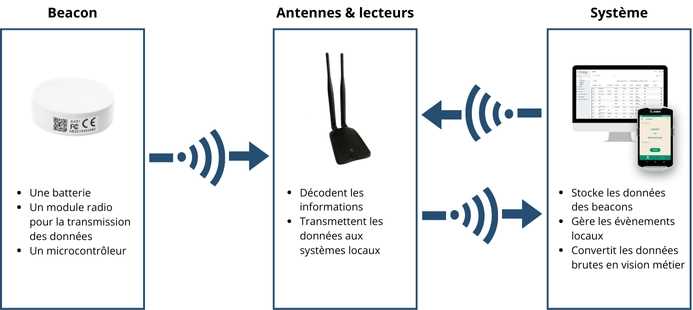
A beacon is a device measuring a few centimeters in diameter that uses Bluetooth Low Energy (BLE) technology to transmit information in the formof radio waves. It is an active tag, meaning that it has its own power source and emits its own signal. The beacon consists of several parts, namely:
- A Universal Unique Identifier, corresponding to a unique identification number
- A radio module
- Sensors
- A microcontroller
- An antenna, whose purpose is to transmit stored information
- A battery, allowing it to operate completely independently, without wires!
How does a BLE beacon work?
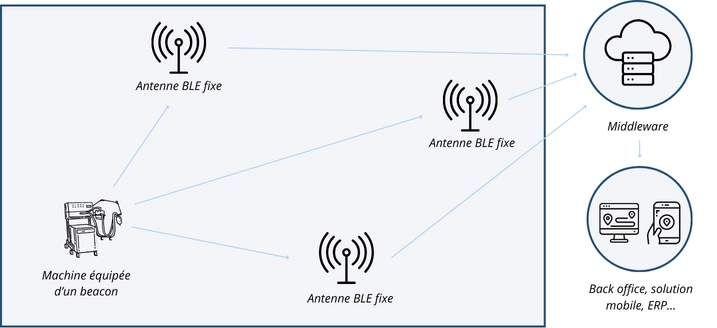
The beacon works in a simple way. Let's say we are in a building covering several hundred square meters and containing several thousand assets. Each asset will be equipped with a beacon that will emit signals at regular intervals. Fixed antennas, similar in size to Wi-Fi antennas, positioned at specific locations in the building, will pick up these signals. Using a triangulation system and based on the strength of the signal received by the antennas, the system will be able to determine the geolocation of the asset or person to within a meter.
The information received by the antennas is then sent to a BLE gateway, which acts as a bridge capable of collecting data. It can then transform the data and transmit it to cloud or on-premise servers.
When should Bluetooth Low Energy tags be used?
Beacons are extremely practical and compact, making them suitable for use in a wide range of contexts. They can be found, for example, at tourist attractions. Imagine that you are welcoming visitors to your park, museum, or estate and would like to send them information as they explore: BLE sensors allow you to do this, provided that the dedicated app is active on their smartphones.
But that's not all!
Beacons are also proving to be strategic for businesses. This is particularly true:
- For asset tracking, as demonstrated above. While RFID allows you to locate the last known location of your asset, beacons enable you to view the location of your equipment in real time. Pallets and vehicles outdoors, but also beds and equipment in hospital logistics: it all depends on your needs.
- To ensure optimal storage conditions. In addition to transferring simple identification data, BLE beacons can also be equipped with temperature sensors. If you have certain traceability requirements, these devices are a wise choice.
- For tracking people. Yes, some bracelets are equipped with beacons, so that the location of individuals can be determined precisely. Depending on the strength of the signals received, the device simply calculates the distances between each element. BLE beacons can also be equipped with accelerometer sensors, allowing users to be notified if a person falls, for example. Whether in prisons, hospitals, or retirement homes, this technology is therefore indispensable.
- In the context of access control. While the idea of badges may seem outdated and time-consuming for users, BLE versions are actually quite interesting. All you need to do is place a beacon in a strategic location on your premises to take advantage of this technology. Every smartphone in the vicinity will be detected and validated (or not!) by the system, acting as an automatic badge.
Beacons are therefore valuable allies inoptimizing flows and managing inventory, while also simplifying decision-making. By extension, this will improve your profitability and the well-being of your employees.
Advantages and limitations of BLE beacons
Like any technology, beacons have strengths and weaknesses when used in business. Here is a closer look at the characteristics of these systems.
What are the advantages of BLE beacon technology?
Among the greatest strengths of BLE beacons, let's highlight four:
- Long service life: As the acronym BLE (Bluetooth Low Energy) suggests, beacons using this communication protocol are very energy efficient. You can therefore easily expect a service life of more than 5 years, which is ideal in an industrial setting.
- Accuracy: They offer high accuracy, similar to NFC, while having a significantly greater range.
- Autonomy: BLE beacons are so popular because they do not require any wires to operate. With their own battery, they can be moved around as desired and are very flexible in terms of logistics.
- Simple implementation: Since Bluetooth Low Energy uses the same frequencies as Wi-Fi, namely 2.4 GHz, it is easy to use. The infrastructure required is similar to that of Wi-Fi.
The limitations of a Bluetooth beacon
The biggest limitation of the beacon is ultimately its battery. Even though it has a lifespan of around five years, the battery will need to be replaced at some point. In this case, depending on your needs, it will be up to you to assess the value of what you want to track in order to calculate the relevance of BLE compared to RFID or barcode technology.
Your questions about Bluetooth Low Energy beacons
Geolocation: BLE or RFID tags?
You may be hesitating between RFID systems and beacons to manage your assets and inventory. In this case, it is important to note that these two technologies do not cover the same needs. If you want to optimize your inventory management, eliminate inventory discrepancies, and perform your inventory counts almost automatically, then RFID technology will be more suitable. However, if you want to geolocate assets or people in real time, then Bluetooth Low Energy will be more appropriate.
In terms of price, BLE beacons are more expensive than RFID tags, but for a complete solution, several factors must be taken into account, such as antennas, terminals, the number of assets to be tracked, etc. These will affect the final price, meaning that a BLE system is not necessarily more expensive than an RFID system.
In concrete terms, we can therefore say that BLE technology and radio frequency identification are complementary. Only a detailed analysis of your needs would enable us to direct you towards one or the other of these solutions.
When were beacons created?
The use of the first beacons is relatively recent, dating back to 2013. At that time, Apple developed the iBeacon protocol to adapt BLE to iOS systems. Since its smartphones were not equipped with NFC technology, this major player offered a convincing alternative. This enabled Apple stores to send offers to their customers and track their movements in-store. Since the emergence of Bluetooth 4.0 in 2010, followed by beacons in 2013, this technology has become widespread. And of course, these small devices are compatible with both Android and iOS!
As you can see, connected objects offer tremendous promise for masterfully managing your inventory, assets, or visitors to your facility. Following RFID, BLE beacons are now being used on a large scale, enabling signals to be sent over long distances. Would you like to learn more or implement this technology in your business? Contact our experts today. From defining your needs to maintaining your systems, including implementation and various testing phases, we take care of everything!
.webp)